How Many Sound Stations Do You Need at a Wedding? From Ceremony to Open Bar Without Pauses
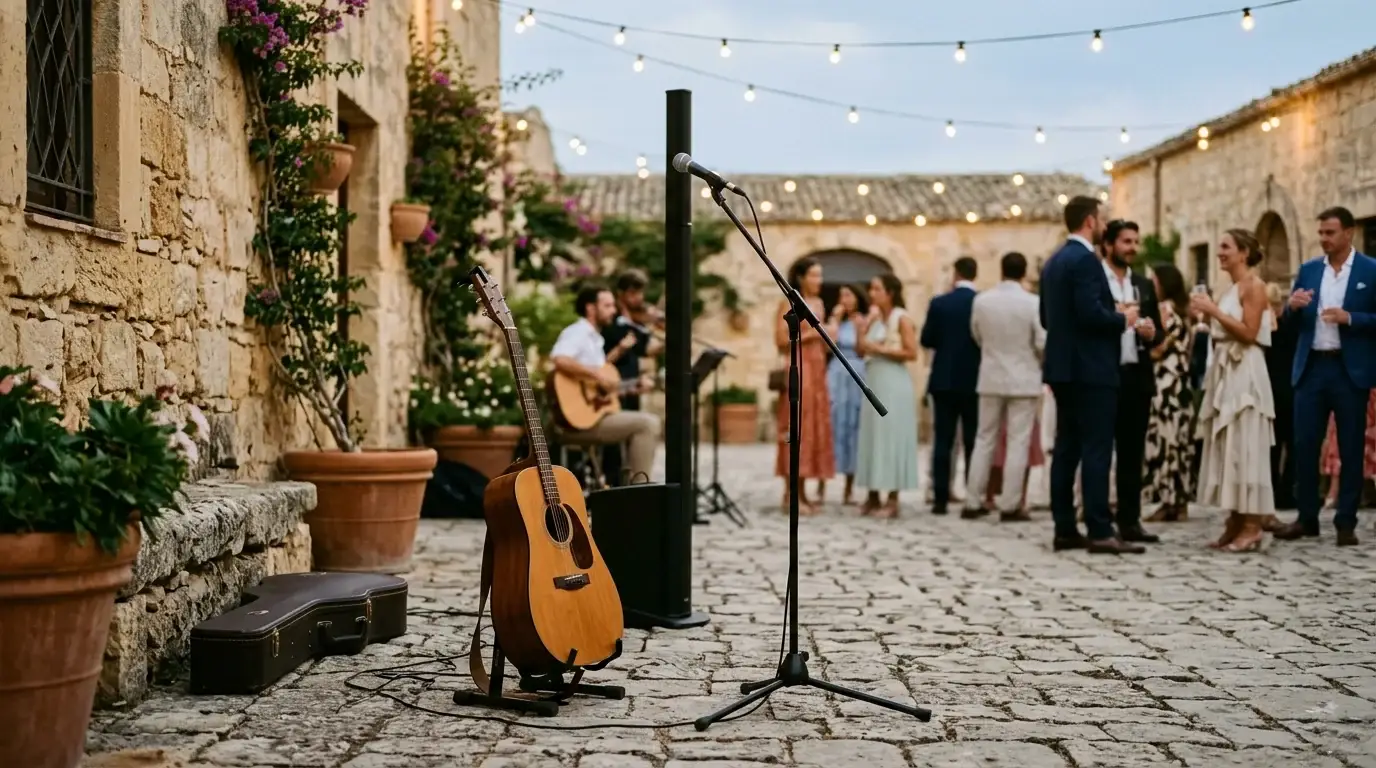
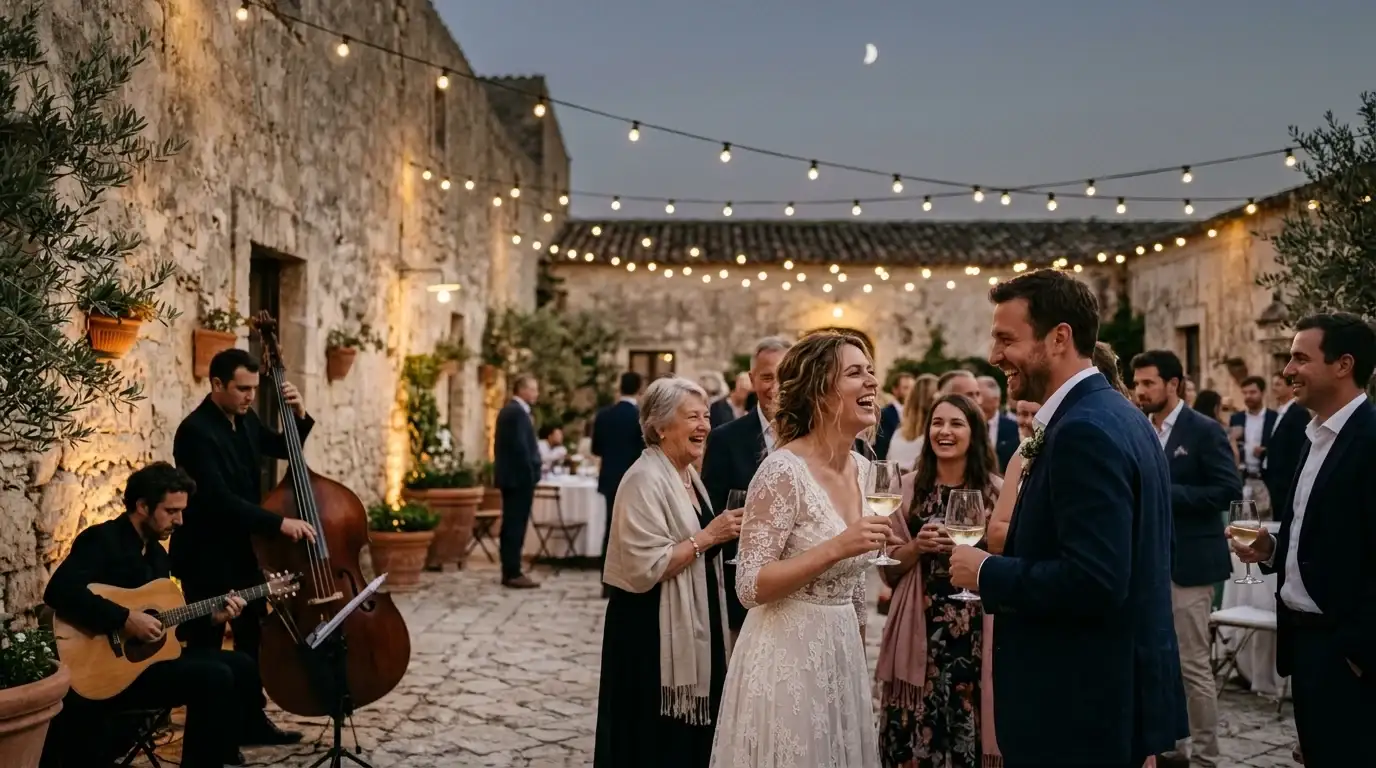
When planning a destination wedding in Sicily, couples envision a seamless cinematic flow: emotional vows under ancient olive trees, sunset cocktails with an acoustic band echoing against stone walls, an intimate candlelit dinner in a historic courtyard, and high-energy dancing under the stars until the early hours.
In practical terms, however, a historic villa, coastal castle, or Sicilian baglio is not a single open room. They are sprawling estates with expansive lawns, panoramic terraces, stone cloisters, and grand indoor ballrooms separated by hundreds of feet of gravel paths and stone stairways.
Couples often ask: “If the band brings a sound system for the cocktail hour, can’t we simply move that speaker to the dinner terrace and then carry it inside for dancing?”.
Experienced sound engineers and wedding production directors give a clear answer: no, unless you are willing to accept dead silences, disrupted pacing, and the visual clutter of equipment being wheeled past your guests.
This guide breaks down how professional multi-station audio management works, how many stations your wedding timeline actually requires, and why seamless sound flow is the invisible backbone of an unforgettable celebration.
Summary Table: The 5 Sound Stations of a Wedding and Their Technical Specs
| Wedding Phase | Typical Venue Space | Recommended Sound Setup | Essential Technical Gear | Sound Pressure dB(A) | Continuity & Production Role |
|---|---|---|---|---|---|
| 1. Ceremony (Civil or Symbolic) | Garden lawn, cloister, or olive grove | Station 1 (Autonomous) | Slim compact column array, compact mixer, 2 wireless microphones (officiant and readings), acoustic instrument inputs | 50–55 dB(A) | Crystal-clear vocal clarity; completely independent from the reception setup |
| 2. Welcome Cocktail Reception | Outdoor gardens, courtyard, pool terrace | Station 2 (Main Live) | Stereo PA system with wide horizontal dispersion, multi-channel stage mixer, microphones and monitors for the live band | 55–60 dB(A) | Starts immediately as guests arrive from the ceremony, without a second of silence |
| 3. Dinner Banquet | Dining terrace or banqueting hall | Station 3 (Background) | Distributed ambient speakers, acoustic/lounge source, 1 wireless microphone ready for toasts | 45–50 dB(A) | Warm background music that never forces guests to shout; toast microphone on standby |
| 4. Cake Cutting & Highlights | Scenic lawn, fountain, or sea view | Extension of Station 2 or dedicated Station 4 | Satellite speaker or dedicated audio feed if the cake is placed far from the cocktail area | 70–75 dB(A) | Synchronized to the exact second with the couple’s arrival, Champagne toast, and photographers |
| 5. Evening Party & Open Bar | Soundproofed indoor hall of the villa | Station 5 (Dance / DJ setup) | High-impact PA with dedicated subwoofers, DJ console, wireless mic, and dance lighting | 80–85 dB(A) | Wired and soundchecked early in the afternoon to respect local outdoor noise curfews |
1. The Myth of the «Traveling Speaker»: What Really Happens When You Move Sound Gear
Attempting to cut production costs by hiring a single sound station and “moving it along” with the guests is one of the most common pitfalls in wedding planning. Here is what physically happens behind the scenes:
- A 25 to 40-minute void of total silence:
To move a live sound setup, technicians must fade the music, shut down amplifiers, unplug signal and power cables, take heavy speakers off tripods, pack instruments into flight cases, wheel carts over gravel walkways or historic stone steps, set up stands again, run power, turn gear back on, wait for digital mixers to boot, and re-check gain levels. Throughout this entire window, guests stand in total silence, wondering whether something went wrong or if the party has stalled. - The “construction site” aesthetic:
While your guests are dressed in formal evening attire enjoying Champagne and hors d’oeuvres, they see technicians sweating in black t-shirts hauling heavy black flight cases, stands, and coils of cable through the tables. The romantic ambiance instantly evaporates. - Severe acoustic mismatch:
A speaker equalized for an open outdoor lawn will sound muddy, boomy, and harsh when hurriedly moved into a historic stone hall with vaulted ceilings and marble floors. Professional venue acoustic management requires precise frequency equalization and phase alignment tailored to each architectural space. - Electrical hazards and ground hums:
Unplugging and replugging heavy electrical loads into unknown domestic wall sockets mid-event can cause loud speaker pops, 50 Hz grounding hums, or even trip the main circuit breakers of an antique estate.
2. How Many Stations Do You Need? 3 Real-World Scenarios
The right number of audio setups depends on how your timeline interfaces with the architecture of your venue:
Scenario A: Church Ceremony + Reception at the Venue (2 to 3 Stations)
When the ceremony takes place in a Catholic church, the venue only hosts the reception:
- Station 1 (Outdoor): for the live band during the welcome cocktail hour and cake cutting;
- Station 2 (Dinner): subtle ambient background sound and a wireless microphone for toasts;
- Station 3 (Indoor): dedicated dance hall setup for the late-night DJ set and open bar.
Scenario B: On-Site Civil/Symbolic Ceremony + Full Reception (3 to 4 Stations)
This is the standard format for destination weddings in Sicily:
- Ceremony lawn: independent compact station with 2 wireless mics and inputs for acoustic instruments (violin, guitar, harp, keyboard);
- Cocktail courtyard: main live band station;
- Dinner terrace: ambient dining audio;
- Indoor ballroom: after-midnight dance party.
Scenario C: Compact Single-Courtyard Celebration (2 Stations)
In smaller boutique venues where aperitivo, dinner, and cake cutting all occur within the same central courtyard, 2 stations are often sufficient: one outdoor multi-purpose setup for the live band and dinner, and one indoor setup prepared in advance for dancing after midnight.
3. Power Management in Historic Sicilian Estates
Historic villas, fortified baglios, and 18th-century palazzos offer unmatched romantic charm, but their electrical grids require technical care.
During dinner, the catering team operates high-power convection ovens, warming cabinets, espresso machines, and portable refrigeration units, drawing between 12 and 18 kW simultaneously.
A professional audio production team conducts a site inspection or coordinates with venue management well before the wedding day to:
- Identify clean electrical circuits completely separate from the catering kitchen lines;
- Distribute sound stations across separate electrical phases (on 380V three-phase venue supplies);
- Utilize modern Class-D powered speakers with high efficiency and minimal power consumption;
- Protect digital consoles and wireless microphone receivers with uninterruptible power supplies (UPS) to ensure flawless operation even if minor voltage dips occur.
4. Key Questions to Ask Your Band and Venue
Before signing your entertainment contract, clarify these five operational points:
- How many physical sound stations are included in the quote? Confirm the exact number of speaker systems, mixers, and microphones, and where they will be stationed.
- What time will sound setup begin? A complete multi-station installation requires 2 to 3 hours. Technicians must arrive early to complete all soundchecks before the first guest walks through the gates.
- Who provides the microphone for dinner toasts? Ensure a wireless handheld microphone is assigned specifically to the maître d’ or best man for spontaneous toasts.
- Is the late-night indoor setup ready in advance? Confirm that the indoor party gear is wired and soundchecked early in the afternoon, allowing dancing to start immediately when outdoor music ends.
- What is the audio rain plan (Plan B)? Check whether your sound team has the flexibility to adapt to covered or indoor spaces without cutting promised live performances.
Frequently Asked Questions About Wedding Sound Stations
How many sound stations are needed if our ceremony is in a church?
If your ceremony takes place in a church, your wedding venue typically requires 2 or 3 independent sound setups: one primary outdoor station for the live band during cocktails and cake cutting, a dedicated background audio setup for the seated dinner, and an indoor high-power sound system for the late-night open bar and dancing.
Can we just use the venue’s built-in background music system?
Most venues’ pre-installed sound systems consist of small 100-Volt ceiling or wall speakers designed strictly for low-fidelity background music. While suitable for soft dinner ambiance, they lack the dynamic range, bass response, and power needed to support a live band or an energetic DJ dance set.
What happens if the cake cutting is in a remote area of the estate?
If your cake cutting takes place on a scenic overlook or distant lawn far from the cocktail area, setting up an independent satellite speaker is essential. Arriving at the cake in dead silence while waiting for someone to drag a speaker across the lawn ruins the emotional impact of the moment.
Does having multiple sound stations double the music budget?
No. An established wedding band or production service incorporates a multi-zone setup with 2 or 3 stations directly into their comprehensive event packages. Adding an extra satellite station (for instance, for a remote ceremony in an olive grove) incurs a modest fee that is well worth avoiding disruptive pauses and amateur logistics.