Wedding Music Curfews and Decibel Limits in Sicily: Rules, Sound Laws & Tips
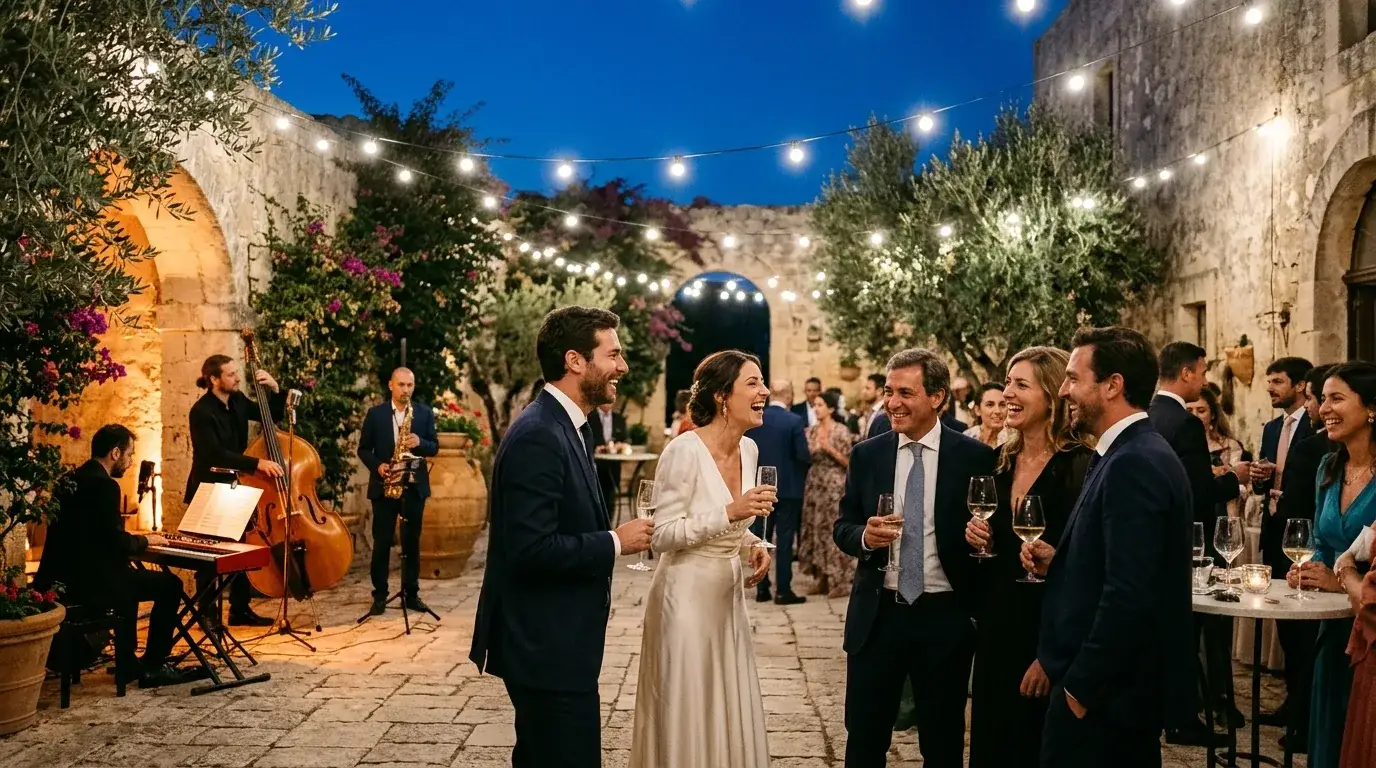
Planning a destination wedding in Sicily paints an unmistakable picture: dining under warm bistro lights, historic stone baglios, and open-air dancing beneath the Mediterranean stars until dawn. Yet, as wedding production details take shape, many international couples and wedding planners encounter an unexpected reality: the venue manager or caterer announces that “at exactly midnight, all outdoor music must be turned off or drastically reduced according to municipal bylaws”.
The initial reaction is often one of disbelief: “What does the law actually require? How late can our band play? Could the local police shut down our wedding? And how do we design our timeline so the party doesn’t end abruptly right when everyone is having fun?”
In this comprehensive guide, we explain the legal noise framework in Sicily, break down how venue decibel limiters work, and show how experienced acoustic musicians and thoughtful sound management allow you to enjoy an unforgettable celebration without risking fines or police visits.
Quick Guide: Noise Curfews, Decibel Limits & Space Management in Sicily
| Reception Phase | Event Space | Typical Timeframe | Recommended dB(A) Level | Legal Framework & Regulations | Production & Musical Strategy |
|---|---|---|---|---|---|
| Guest Welcome & Cocktail Hour | Gardens / Outdoor Courtyard | Until 8:30 PM | 55–60 dB(A) | Ambient comfort & easy conversation | Refined live acoustic set (duo or trio) |
| Seated Dinner | Terrace or Banquet Hall | 8:30 PM – 11:00 PM | 45–50 dB(A) or silence | Dining etiquette & speech intelligibility | Subtle background playlist or solo grand piano |
| Cake Cutting & First Dance | Lawn / Poolside / Courtyard | 11:00 PM – 12:00 AM | 70–75 dB(A) | Pre-curfew highlight window | Triumphant live crescendo before midnight |
| Outdoor Late-Night Dancing | Open-air unshielded spaces | Past 12:00 AM (or 1:00 AM) | Max 55–60 dB(A) | Town ordinances & Art. 659 Criminal Code | High volume banned; switch to low ambient or silence |
| Indoor Party & Open Bar | Soundproofed indoor salon | Until close (2:00 AM – 3:00 AM) | 80–85 dB(A) | Closed doors & acoustic sound absorption | Dedicated indoor sound system with dance floor |
1. Noise Regulations in Italy: Framework Law, the Criminal Code & Sicilian Ordinances
Live musical entertainment at private wedding receptions operates within a specific statutory framework. In Italy, environmental noise is governed at the national level by Framework Law 447/1995 on Noise Pollution and D.P.C.M. 14/11/1997, which define maximum acoustic emission standards and differential noise thresholds (the difference between ambient noise with music playing versus baseline background noise).
From a compliance and liability perspective, Article 659 of the Italian Criminal Code (disturbance of public rest or occupation) penalizes anyone who generates excessive noise that disturbs neighbors or the local community through sound amplification equipment.
Summer municipal ordinances in Sicily
Throughout Sicily, where the outdoor wedding season runs intensely from May to October, individual municipalities (such as Palermo, Cefalù, Bagheria, Taormina, Agrigento, and Noto) publish annual mayoral ordinances (ordinanze sindacali) to regulate outdoor sound levels and protect residential peace:
- Sunday through Thursday (weekdays): Outdoor amplified sound must stop or drop to non-intrusive levels at midnight (12:00 AM).
- Fridays, Saturdays, and holiday eves: Extended cutoff times are generally granted until 1:00 AM (rarely up to 1:30 AM or 2:00 AM, and only in remote zones with no neighboring residences).
- Past the curfew: No sound clearly audible beyond property borders is legally allowed in outdoor areas, except for whisper-level ambient music.
[!IMPORTANT] “We are out in the countryside” is a common misconception: many breathtaking Sicilian estates, baglios, and seaside villas are located in scenic rural valleys with private residences or holiday villas within 300 to 500 meters. Late at night, as ambient road traffic subsides and cool coastal breezes carry acoustic waves, low frequencies (bass and kick drums) carry across valleys for kilometers.
2. Decibels Explained Simply: What 55 dB, 70 dB, and 85 dB Mean in Practice
Venue contracts frequently quote sound limits in decibels (expressed as dB(A)) without explaining how that translates to the reception atmosphere. Because the decibel scale is logarithmic (every 3 dB increase doubles acoustic sound energy), small numerical changes create dramatic differences in volume:
- 45–50 dB(A) — Gentle Whisper & Calm: the typical ambient level of an upscale restaurant or rustling leaves. This is the optimal volume for seated courses, allowing guests of all ages to converse comfortably without shouting across the table.
- 55–60 dB(A) — Relaxed Conversation: the sound pressure of four people conversing normally. This is usually the legal threshold permitted outdoors past midnight near the estate boundary.
- 70–75 dB(A) — Acoustic Live Performance: the volume of an acoustic ensemble featuring piano, upright bass, lead vocals, and saxophone performing swing or sophisticated pop during cocktails or the cake cutting. The music is prominent and warm without causing ear fatigue.
- 80–85 dB(A) — Full Dance Party: the energy required to create a compelling, vibrant dance floor. At this volume, dancing outdoors past midnight is virtually guaranteed to trigger complaints unless moved into an enclosed ballroom.
3. Acoustic Limiters and Venue Decibel Meters: How They Work
In recent years, to protect against neighbor complaints and municipal police fines, many historic villas and castles across Sicily have installed permanently sealed decibel meters (fonometri) paired with automatic power breakers.
How does a sound limiter operate?
- A calibrated reference microphone is mounted in the courtyard or terrace ceiling.
- The central processor calculates the equivalent continuous sound level (typically averaged over 1-minute or 5-minute rolling windows).
- If the band or sound engineer exceeds the programmed ceiling (such as 75 dB(A) or 80 dB(A)), a warning indicator displays a yellow warning light.
- If excessive volume persists, the device automatically trips the main electrical circuit to the stage, cutting all power and plunging the performance into total silence for several minutes.
[!TIP] The acoustic advantage of a seasoned live band: a professional acoustic band accustomed to historic estates possesses a level of dynamic control that generic high-gain pre-recorded playback cannot deliver. Performing on authentic acoustic instruments (piano, sax, upright bass, harmonized vocals), our musicians immediately modulate their dynamics to match the venue’s acoustic response, preventing sharp frequency spikes from tripping the venue’s limiter.
4. Municipal Sound Waivers (Deroga Acustica): Who Applies and What Is Covered?
A temporary acoustic waiver (deroga acustica per manifestazioni temporanee ed eventi privati) is an administrative permit issued by the municipal business office (SUAP) of the local town hall.
Key facts couples need to know:
- Who is responsible for the application? In standard venue rentals, the venue owner or estate manager files the technical dossier, prepared by a certified environmental acoustics technician (Tecnico Competente in Acustica Ambientale). However, in dry-hire private villas, the rental agreement may require the couple or their wedding planner to submit the paperwork.
- What does the permit actually grant? The waiver allows sound levels to moderately exceed normal residential baseline thresholds for a defined time window (for example, permitting up to 70 dB(A) outdoors until 1:00 AM instead of midnight). No municipal waiver authorizes unlimited volume all night outdoors.
- Filing timeline: Applications must be submitted 15 to 30 days prior to the wedding date, accompanied by administrative town hall fees.
5. Keeping the Party Alive: The Two-Phase Musical Timeline
Knowing in advance that an outdoor sound curfew applies at midnight does not mean cutting short your celebration. It simply requires designing your wedding music timeline with professional staging intelligence.
Here is our proven two-phase formula refined across Sicily’s finest wedding venues:
[6:30 PM – 8:30 PM] Outdoor Gardens: Ceremony & Acoustic Cocktail Hour (55–65 dB)
       │
[8:30 PM – 10:30 PM] Courtyard or Hall: Dinner with warm ambient background (45–50 dB)
       │
[10:45 PM – 11:45 PM] Terrace / Poolside: Triumphant Cake Cutting & First Dance (70–75 dB)
       │
       ▼ (Outdoor sound curfew takes effect: 12:00 AM)
[12:00 AM – 2:30 AM] Indoor Soundproofed Hall: Full Dance Party & Open Bar (80–85 dB)
Why this structure guarantees success
- Zero awkward stops: guests do not experience an abrupt shutdown; instead, the transition feels like a natural progression of the evening into a vibrant, late-night party space.
- Dual pre-wired sound setups: as outlined in our wedding music checklist, the musicians or audio technicians set up a secondary sound station in the indoor hall during afternoon setup, allowing the party to resume indoors within seconds.
- Peace of mind for everyone: the wedding stays fully compliant with local bylaws, shielding newlyweds and venue staff from unexpected fines, neighbor disputes, or police visits.
Checklist: 5 Questions to Ask Your Venue Before Signing the Contract
Before confirming your deposit for a Sicilian wedding venue or castle, secure written answers to these five essential questions:
- What is the exact outdoor music curfew? Clarify the precise hour for your chosen day of the week (weekday vs Friday/Saturday).
- Does the estate hold an active municipal noise waiver for the current season? Ask for a copy of the town hall permit and note any specific decibel caps.
- Is there an active decibel limiter installed in the courtyard or garden? Knowing whether an automated circuit breaker exists and its calibrated limit is crucial for your music providers.
- Is there an indoor hall authorized for late-night music after midnight? Confirm that the indoor space has sufficient room for your guest count, an open bar, and a dedicated secondary audio setup.
- Who holds legal liability for noise complaints? Check the rental terms to understand how neighbor disputes or municipal citations are assigned.
Frequently Asked Questions About Music Curfews and Sound Limits in Sicily
How late can a live band play outdoors at a wedding in Sicily?
In most Sicilian municipalities (such as Palermo, Cefalù, Bagheria, Taormina, Noto, and Syracuse), summer municipal bylaws mandate that outdoor amplified music cease at midnight (12:00 AM) on weekdays (Sunday through Thursday) and at 1:00 AM on weekends (Friday and Saturday) and holiday eves. After these hours, outdoor sound must be reduced to faint ambient conversation levels, or the party must move inside an enclosed hall.
What happens if the police are called due to loud music at a wedding?
If local police (Polizia Municipale) or Carabinieri receive a noise complaint (under Article 659 of the Criminal Code), officers will visit the property to measure sound emissions and verify compliance with municipal permits. If noise limits or curfews are breached, they will order the sound system to be turned off immediately and may issue administrative fines to the venue management or the event host.
Who is legally liable for noise infractions at a private wedding?
Administrative and civil liability primarily rests with the venue operator (who is responsible for complying with venue entertainment licenses and municipal ordinances) and the newlyweds as the event organizers and holders of the SIAE music permit. Musicians are legally obligated to follow the sound level and timing instructions set by the venue management and local authorities.
How can we continue dancing after the outdoor sound curfew?
The most seamless and elegant approach is to plan a dual-location party from day one: hold your cocktail reception, dinner, and cake cutting outdoors in the courtyards or terraces, and move the dancing and open bar into an enclosed, soundproofed indoor salon of the villa with windows and doors shut. A professional band or sound production team will pre-wire an indoor sound setup in the afternoon, allowing an instant, seamless continuation of the party.