Duo, Trio, Quartet or Quintet: Which Line-up to Choose for Your Wedding
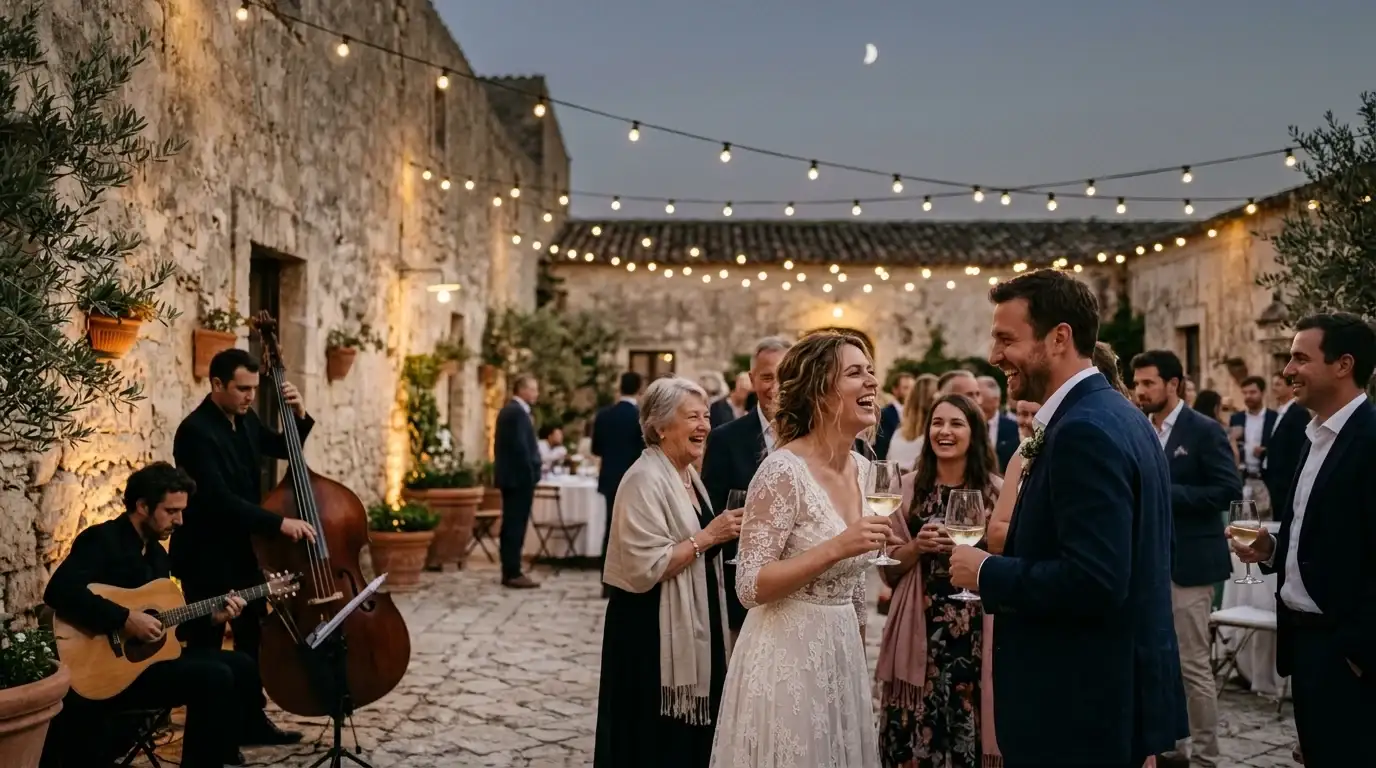
How many people should play at your wedding? It is the question we are asked most often, and the answer is surprising: there is no single line-up for the whole day. A good musical direction uses different line-ups for different moments, and the number of musicians grows with the mood of the party.
In this guide we explain how we think when we build the music of a wedding in Sicily, moment by moment, and how to choose between duo, trio, quartet and quintet.
The principle: a crescendo from the ceremony to the party
A wedding day has a rhythm, and the music follows it: sober during the ceremony, soft at the aperitivo and the starters, fuller and fuller at lunch or dinner and in the dancing. The line-ups we offer are the typical ones for a precise reason: each serves its own moment.
| Moment | Typical line-up | Why |
|---|---|---|
| Civil ceremony | Solo piano, piano and voice, piano and violin, trio with voice, violin and piano | A ritual moment: no drums, usually no electric bass, music that does not cover the words |
| Aperitivo and starters | Solo piano, duo (piano and voice or piano and sax) or trio | A soft accompaniment that lets guests talk and prepares the build-up |
| Reception: lunch or dinner | Quintet with sax or trumpet; the quartet as an alternative | The complete line-up, with the full rhythm section |
| Reception and dance break | Quintet with sax (or quartet) | Accompanies the banquet with classy listening music, opens the dance break between courses, and culminates in the emotional cake cutting. |
The civil ceremony: why a small line-up
For the civil ceremony we offer four solutions: solo piano, piano and voice, piano and violin, piano, voice and violin. A soprano sax can take the place of the violin. The choice does not depend on the number of guests, but on the nature of the moment:
- It is a ritual moment: people speak, read texts, exchange rings. The music must not cover speeches and vows with loud volumes.
- Even the passages without words call for restraint: the entrance of the bride and groom, the exchange of rings, the exit. Here too, no noise: it is a ceremony, so no drums and, usually, no electric bass.
- A self-contained, discreet sound system is needed, with microphones for the couple and the celebrant.
Go deeper with Civil ceremony music: the guide for couples.
Aperitivo and starters: the duo or the trio
The aperitivo and the starters come after the ceremony and before the reception: guests chat, toast and move between spaces. Here solo piano, a duo or a trio are enough, depending on the mood:
- Duo: piano and voice, or piano and sax, for a soft accompaniment.
- Trio: voice, piano and a third instrument (violin, sax or bass), for a richer sound that stays at low volume.
This is where the crescendo begins: the music rises gently, until the entrance to the reception room. Go deeper with Wedding aperitivo: which background music to choose.
The reception: quartet or quintet?
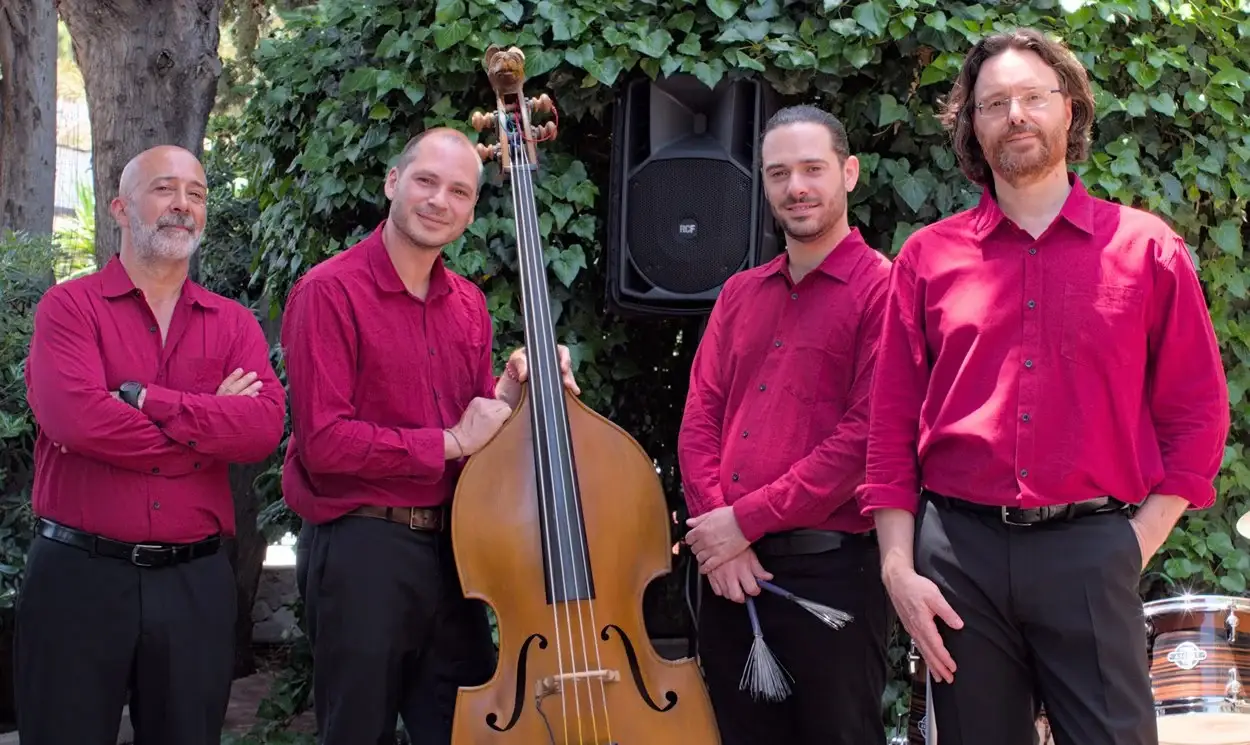
At lunch or dinner the line-up widens. The quartet (voice, piano, bass and drums) is already a complete line-up and the minimum requirement for the dance break between courses, where drums are essential. The quintet with horns, meaning the quartet enriched by saxophone (or trumpet), is the richest and most versatile solution: it provides a soft, elegant atmosphere during the banquet and maximum tonal energy when guests get up for the dance break.
As a rule we recommend the quintet, because it is musically more complete. Here is when to choose otherwise:
| Situation | Recommended line-up |
|---|---|
| Large room, 200 or more guests, dance break | Quintet, decidedly |
| Reception with no particular constraints | Quintet: it is musically more complete |
| Smaller budget | Quartet |
| Tight spaces | Quartet |
| Room for no more than two or three musicians | Duo or trio |
| The couple prefers a less powerful sound, without sax or trumpet | Quartet |
Space rarely shapes the choice, and only when there is room for no more than two or three members of the band. The couple’s taste matters: some feel that sax and trumpet make too much noise, and that is perfectly fine. In that case the quartet is a legitimate choice.
How to choose, in practice
Five questions help you decide:
- Is there a dance break during the reception? If so, at least the quartet, preferably the quintet.
- Is the room large or are the guests many (200 or more)? The quintet.
- What mood do you want at the reception? Softer, the quartet; more brilliant, the quintet.
- What is the budget? Smaller line-ups cost less: we talk about it in the cost guide.
- How much room is there for the musicians? If there is room for two or three, the choice is between duo and trio.
If the line-up changes from one moment to the next, a sound system must be ready in every space: the guide to sound stations explains how it is organised.
Frequently asked questions about the wedding line-up
How many musicians do you need for a wedding?
It depends on the moment: from one or two musicians for the civil ceremony and the aperitivo, to four or five to accompany the banquet with listening music, handle the dance break between courses, and provide the emotion for the cake cutting. The line-up grows harmoniously with the day.
Does the number of guests decide the line-up?
Not on its own: what matters is the moment, the dance break, the room, and the couple’s taste. With a large room, 200 or more guests, and the desire to get guests dancing between courses, we decidedly recommend the quintet.
Do you need drums at a civil ceremony?
No. The ceremony is a ritual moment: no drums and, usually, no electric bass. Solo piano, a duo or a trio are used, because the music must not cover speeches and vows.
Quartet or quintet for the reception?
As a rule the quintet, because it is musically more complete. The quartet is the right choice for tight spaces, a smaller budget or if the couple prefers a sound without sax or trumpet.
Which line-up plays at the aperitivo?
Solo piano, a duo (piano and voice or piano and sax) or a trio: a soft accompaniment, at low volume, that lets guests talk.
Does the line-up change if the room is small?
Rarely. Only when there is room for no more than two or three musicians is the choice between duo and trio; in tight but not minimal spaces you can opt for the quartet.
Is it better to have a single line-up for the whole day?
We recommend not: using different line-ups for each moment creates a crescendo, from the sobriety of the ceremony to the fullness of the dancing.
Conclusion: the right line-up is the one for the moment
There is no absolutely best line-up, only the right one for each part of the day. If you already have a date and a venue, get in touch: we will build the line-up for each moment together and send you a tailored quote.